Staged Robbery in Madhya Pradesh Conceals Calculated Murder Plot
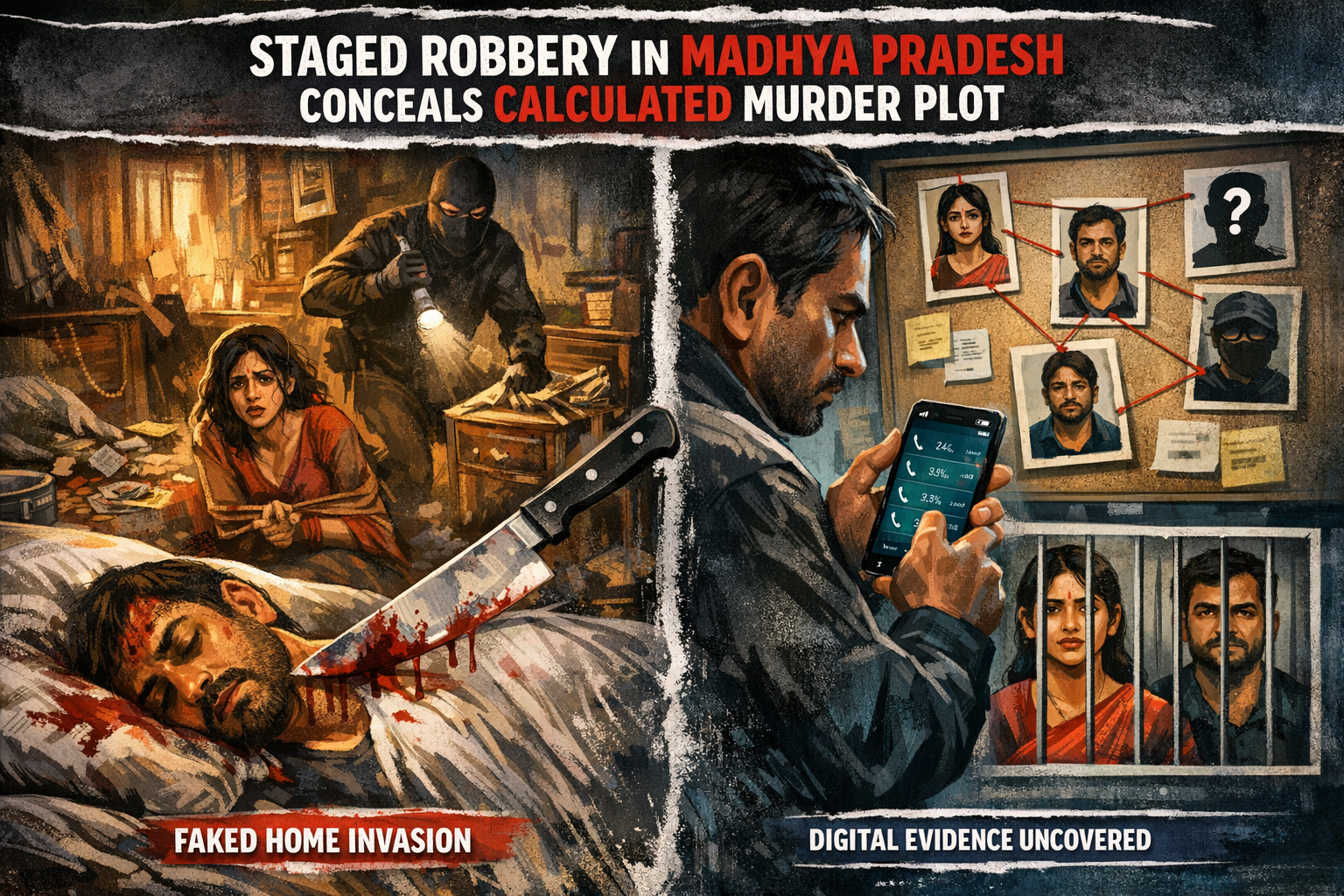
What appeared to be a violent home intrusion in Gondikheda village, Dhar district, Madhya Pradesh, unravelled within 36 hours as a deliberately constructed homicide — allegedly orchestrated by the victim's wife, Priyanka, in collaboration with her lover. Her husband, Devkrishna, was killed with a sharp weapon while asleep, and the scene was manipulated afterward to suggest a robbery gone wrong. The case is a textbook illustration of how investigative forensics and digital evidence can cut through carefully staged deception.
The Manufactured Crime Scene
Priyanka's account to police was precise enough to sound credible: unknown intruders had entered the home at night, attacked her, ransacked the property, and killed Devkrishna. She was found physically distressed, items were scattered across the house, and she appeared to have been restrained. The picture fit a recognisable pattern of rural property crime, and on the surface, there was little to challenge it.
But investigators noticed early that the details did not hold. The sequence of physical evidence — the positioning of objects, the nature of the victim's injuries, the manner in which Priyanka was tied — did not correspond to how an actual break-in of that kind would typically unfold. Crime scene staging, while not uncommon in domestic homicides, tends to leave traces: arrangements that are slightly too deliberate, injuries inconsistent with the claimed sequence of events, and a narrative that accounts for too many variables too neatly.
Digital Evidence and the Role of Call Records
The investigation shifted decisively when police examined digital evidence and call records. These revealed an established relationship between Priyanka and a man named Kamlesh. In cases involving intimate partner homicide — a category that Indian law enforcement has increasingly been required to confront — the presence of a third party with motive often becomes the central thread. Here, it was.
According to police, Kamlesh recruited a third individual, Surendra, and allegedly arranged payment of approximately ₹1 lakh as a contract fee for carrying out the killing. Devkrishna was attacked while asleep, which speaks both to the premeditated nature of the act and to the assailants' access — or familiarity — with the household's routines. After the killing, the staging was performed: items displaced, Priyanka restrained, an alarm raised to summon neighbours and eventually police.
Contract killings in rural India, while not statistically dominant, are not rare in cases involving domestic disputes, property, or intimate relationships. The relatively modest sum allegedly involved — ₹1 lakh — reflects a troubling pattern in which human life is assigned a transactional value within informal criminal networks.
Cracking the Case: Method and Timeline
Police cracked the case within 36 hours — a timeline that reflects the weight digital evidence now carries in on-ground criminal investigations. Call data records, cell tower triangulation, and messaging histories have become standard tools in rural as well as urban investigations, dramatically compressing the time required to identify likely suspects when physical evidence is ambiguous or manipulated.
Priyanka and Kamlesh have both been arrested. Surendra, the third alleged participant, remains at large, with a search underway. Authorities have confirmed that what was reported as a robbery was, by all available evidence, a pre-planned murder involving at least three individuals, with the victim's own wife as an alleged architect of the conspiracy.
Broader Implications: Domestic Homicide and the Limits of Surface Narrative
This case sits within a larger, deeply concerning pattern. Domestic homicides that are staged as accidents, suicides, or external crimes are not a phenomenon unique to any one region. They occur across economic and social contexts, and they consistently exploit the initial assumptions investigators bring to a scene. A distressed spouse, a ransacked room, and an absent perpetrator form a narrative that investigators are primed to accept — which is precisely why staging works as often as it does.
What this case demonstrates is the importance of first-response scepticism — not suspicion of victims as a default, but a disciplined refusal to allow initial appearances to foreclose investigative lines. The 36-hour resolution in Dhar was possible because investigators chose to interrogate the scene rather than simply document it. That methodological discipline, combined with the now-routine availability of digital footprints, is changing the landscape of criminal investigation in India and beyond.
Priyanka and Kamlesh face serious charges. The legal process will determine culpability. But the case has already exposed something significant: a staged crime scene is not an alibi — it is, increasingly, evidence of its own.